UC-01
INGEST OPPORTUNITIES
Collect and normalize software offers into a consistent local dataset.
SYSTEM 02
LOCAL AI / HUMAN-IN-THE-LOOP / PERSONALIZED ML
Local-first software opportunity intelligence and project automation system connecting offer ingestion, structured LLM analysis, human feedback, reusable capability matching and controlled personalized ML experiments.
SYSTEM IDENTITY
SYSTEM IDKULAI-STUDIO-02
STATUSACTIVE SYSTEM / ML R&D
TYPELOCAL AI / ML / AUTOMATION
Opportunity intelligence system connecting structured AI analysis, human feedback, personalized learning and reusable software delivery.
01 / OVERVIEW
KulAI Studio started as a way to organize reusable software delivery. It has grown into a local-first opportunity intelligence system connecting source acquisition, normalization, local LLM analysis, capability matching, human review, ranking, ML research and delivery tooling.
The system separates two questions: what does this project actually require, and is this project a good opportunity for this specific developer and workflow? The local LLM primarily addresses the first question. Personalized ML research addresses the second.
Every manually reviewed offer can become additional supervised evidence for future evaluation. The intended loop is controlled: collect new human labels, retrain a fresh candidate on the full dataset, compare it with the baseline and current model, then promote only after evidence.
02 / PROBLEM
UC-01
Collect and normalize software offers into a consistent local dataset.
UC-02
Use a local language model to turn natural-language briefs into validated structured requirements.
UC-03
Compare requirements against reusable KulAI Modules and identify existing, extendable and project-specific work.
UC-04
Record explicit human decisions, ratings, tags and rationale rather than treating model output as ground truth.
UC-05
Use supervised ML experiments to learn which automatically observable offer signals correlate with real human decisions.
UC-06
Connect selected opportunities to reusable project-generation and delivery workflows.
03 / SYSTEM PIPELINE
DATA FLOW
DECISION FLOW
The data flow has a clear responsibility boundary: the local LLM converts unstructured offer text into a versioned structured semantic representation. Qwen is not presented as the personalized decision model.
Personalized ML consumes automatically available offer features and predicts human preference. It answers a different question from semantic parsing and is evaluated separately.
04 / HUMAN FEEDBACK
Model output is not treated as ground truth. The review workspace stores APPLY / MAYBE / REJECT decisions, six independent 1-10 dimensions, tags, free-form rationale and notes, append-only review history, and independent offer workflow state.
HF-01
APPLY / MAYBE / REJECT is the primary supervised target.
HF-02
Six separate dimensions preserve more information than one aggregate score: interest, technical fit, profitability, scope quality, KulAI value and win chance.
HF-03
Tags and free-form notes preserve why two apparently similar opportunities may lead to different decisions.
HF-04
Review revisions remain historical rather than being silently overwritten, alongside independent workflow state.
Human ratings and notes are not used directly as E1 inference features because they do not exist before a new offer is reviewed. They are supervision and evaluation evidence, not leaked inputs.
05 / ML R&D
Can automatically available offer information predict real APPLY / MAYBE / REJECT decisions? The research deliberately compares increasingly richer representations instead of assuming that a more complex model is automatically better.
E0
Existing hand-designed Offer Ranking V1. It is the baseline that learned models must beat.
E1
A 31-feature structured Logistic Regression baseline evaluated with deterministic out-of-fold predictions.
E2
E1 plus leakage-safe TF-IDF from canonical title and description, evaluated on the same folds.
BENCHMARK
E1 and E2 compared on 123 shared samples. E1 remains rank 1 on macro-F1; E2 is not presented as the overall winner.
E3
E1 plus pretrained semantic text embeddings, measuring whether semantic similarity adds information beyond lexical features.
E4
Historical notes provide privileged supervision. Notes are not directly required at inference time; future models may learn rationale dimensions from the offer itself.
E5
Predict the six human rating dimensions from offer data and test whether out-of-fold predicted ratings improve final decision ranking.
06 / EXPERIMENT DESIGN
RND-01
Each historical offer is represented once using its latest human review and latest valid structured analysis.
RND-02
Human decision, ratings, notes and workflow state are not E1 input features because they do not exist before a new offer is reviewed.
RND-03
Experiments use the same deterministic stratified folds for fair comparison.
RND-04
Training rows are evaluated only by models that did not train on those rows.
RND-05
Evaluation will cover classification and queue quality, including Precision@K, NDCG@K, Macro F1 and Balanced Accuracy. Values are not published before measurement.
RND-06
Planned prospective test: a new offer is predicted before review, the prediction stays hidden, the human labels independently, and only then is the prediction evaluated.
07 / INTERFACE
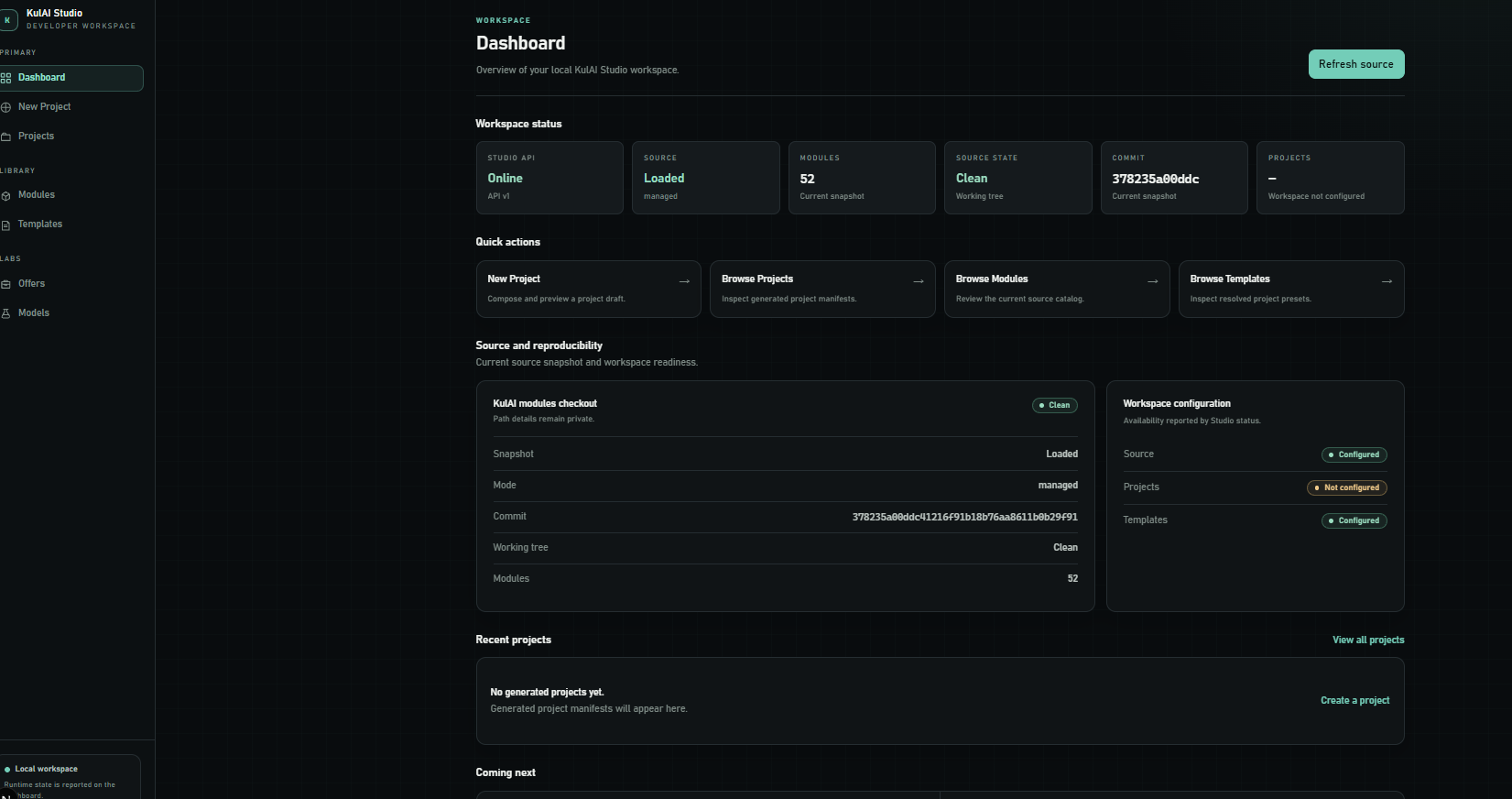
The current UI covers the dashboard, project creation, offer acquisition and synchronization, offer review, human decisions and independent workflow tracking. It does not present an ML prediction dashboard yet.
08 / ENGINEERING
ENG-01
Offer interpretation runs against a local language model instead of requiring a hosted inference dependency.
ENG-02
LLM output is validated into versioned structured contracts rather than being treated as arbitrary prose.
ENG-03
Human decisions remain authoritative and separate from model predictions.
ENG-04
A hand-designed ranking baseline remains available so ML improvements can be measured rather than assumed.
ENG-05
Frozen dataset fingerprints, deterministic splits and OOF evaluation make experiments comparable.
ENG-06
KulAI Modules and project-generation paths connect analysis with actual software delivery.
09 / TECH STACK
STACK-01
Local control plane, application logic and automation.
STACK-02
Normalized offer, analysis, review and workflow persistence.
STACK-03
Semantic parser for structured offer analysis.
STACK-04
Strict structured contracts around model output and application boundaries.
STACK-05
Supervised personalization research starting with an interpretable Logistic Regression baseline.
STACK-06
Reusable capability catalog and software delivery foundation.
10 / STATUS
WORKING SYSTEM OFFER INGESTION / STRUCTURED LOCAL LLM ANALYSIS / CAPABILITY MATCHING / HUMAN REVIEW / WORKFLOW TRACKING / DETERMINISTIC RANKING / PROJECT DELIVERY TOOLING
COMPLETED R&D E1 STRUCTURED BASELINE / E2 STRUCTURED + TF-IDF / FORMAL PAIRED BENCHMARK
NEXT DATA STRATEGY MORE INDEPENDENT REVIEWS / DECISION-BOUNDARY EXAMPLES / HISTORICAL FEATURE SNAPSHOTS